What to Expect in the First Days, Weeks and Beyond…
If you have just started taking black seed oil, you probably want a simple answer: “When will I feel something?”
The honest answer is: it depends.
Some people notice a difference in how they feel within a few days. Others don’t notice anything immediately and need several weeks of consistent use before they feel that something has changed.
And there is an important distinction between feeling a difference and measuring a biological change. They are not necessarily the same thing.
At Toca Essentials, we have seen enough real-world experiences to know that people respond differently to black seed oil. Some customers talk about improved energy or easier bowel movements. Others describe changes in mobility or simply feeling better overall.
My own first experience with black seed oil was surprisingly noticeable.
My First Experience With Black Seed Oil
I first started taking black seed oil a few months after giving birth in 2021.
I remember feeling as though my digestive system had suddenly woken up. I experienced what I would describe as a light digestive “detox” and noticed a significant increase in my energy levels.
I felt lighter.
I also noticed changes in my body that, at the time, I associated with recovering and getting back to feeling like myself after childbirth.
That experience stayed with me because it taught me something I now tell customers:
Don’t assume your experience will be exactly the same as someone else’s.
Black seed oil isn’t an instant-fix product, and there isn’t a universal countdown clock that says, “Day 4: results.”
Your body, your diet, your consistency and what you are hoping to achieve all matter.
So, How Long Does Black Seed Oil Take to Work?
Based on our experience with customers, some people report noticing subtle changes within the first few days, while others take several weeks before they notice anything meaningful.
A practical way to think about it is:
The first 1–7 days
Some people may notice changes in digestion, bowel movements, energy or how they feel generally.
For others, nothing obvious happens yet.
That doesn’t necessarily mean the oil isn’t doing anything. It may simply mean that a noticeable change takes longer—or that the person isn’t going to experience an obvious sensation at all.
Weeks 2–4
This is where consistency becomes more important.
Instead of asking yourself after every dose, “Can I feel it working?”, look at the bigger picture.
Are you noticing changes in your energy?
How is your digestion?
Are your bowel movements more regular?
How do you feel during your normal activities?
Are there changes in something you have been monitoring?
Keeping a simple wellness journal can actually be more useful than relying on memory.
8–12 weeks and beyond
Some of the human research on Nigella sativa has evaluated outcomes over several weeks or months rather than days.
For example, randomized clinical trials examining blood-glucose and cardiometabolic measures have used periods such as 8, 12 and 24 weeks. Recent systematic reviews have also found potential effects on markers such as fasting blood glucose and HbA1c, while emphasizing that more research is needed to establish the ideal dose and duration.
That is very different from saying that everyone will “feel black seed oil working” after 8 weeks.
It simply means that some outcomes need time to measure properly.
What Have Toca Essentials Customers Experienced?
One of the things that makes our experience different is that we don’t only look at black seed oil from a product perspective.
We listen to the people using it.
Over time, customers have shared experiences including:
- feeling that they had more energy
- improved mobility
- easier or more regular bowel movements
- feeling generally lighter and better
- improved stamina during physical activity
One customer who regularly experienced constipation told us that their bowel movements became easier after using black seed oil consistently.
Another customer described feeling that they had more control over their day because they felt more energetic.
These are individual customer experiences, not guarantees of what black seed oil will do for everyone.
And that distinction matters.
Three Experiences That Stayed With Us
1. The gentleman who had struggled with recurring skin blisters
One of the most memorable stories involved an elderly gentleman in his 70s who had experienced recurring skin blisters and had been seeing a dermatologist for years.
After incorporating black seed oil into his routine, he reported that the affected areas began to improve.
We cannot say that black seed oil cured his condition.
We don’t have the clinical information to make that claim—and responsible wellness businesses shouldn’t turn a customer’s experience into a medical promise.
What we can say is that this was his reported experience, and it was significant enough for him to share it with us.
2. The woman who wanted to feel more in control of her energy
Another woman had been struggling with maintaining her energy and managing her blood-sugar levels.
After using black seed oil, she told us that she felt more energetic and more in control of her day-to-day life.
Again, this is an individual experience rather than evidence that black seed oil treats diabetes.
Interestingly, there is some clinical research investigating Nigella sativa and blood-glucose regulation. Several randomized trials and recent meta-analyses have reported improvements in measures such as fasting blood glucose and HbA1c, although the studies vary considerably in dose, preparation, duration and quality.
That is why we encourage people managing blood sugar to monitor their levels and speak with their healthcare professional rather than replacing prescribed treatment with black seed oil.
3. The runner who incorporated black seed oil into his routine
We have also had a runner who used black seed oil as part of his pre-run wellness routine and reported that it helped him feel that he could maintain his stamina during his runs.
That doesn’t mean black seed oil is a performance-enhancing drug or that every runner will experience the same thing.
It is simply an example of how people sometimes incorporate traditional wellness ingredients into their existing routines.
Why Do Some People Notice Something Quickly While Others Don’t?
This is one of the most important parts of the answer.
Your body isn’t a machine with a standard response time.
At Toca Essentials, we believe several factors can influence someone’s experience.
1. Consistency
Taking something once and expecting a dramatic change is rarely a realistic approach to wellness.
If black seed oil is part of your routine, consistency matters.
2. Diet
Your overall diet matters.
Someone eating a fibre-rich, nutrient-dense diet and drinking enough water may have a very different digestive experience from someone whose diet is low in fibre and heavily processed.
You cannot expect one ingredient to compensate for everything else happening in your lifestyle.
3. Individual biology
People are different.
Genetics, metabolism, age, lifestyle and existing health circumstances can all influence how someone responds to a supplement or food ingredient.
4. What you’re actually looking for
“Working” can mean completely different things to different people.
One person may be looking at digestion.
Another may be interested in energy.
Another may be monitoring a blood marker.
Another may simply want to support their general wellness.
Those things cannot all be measured on the same timeline.
How We Use Black Seed Oil at Toca Essentials
For our own wellness routine, I personally use black seed oil differently from someone who is taking it continuously.
One approach I have found useful for myself is incorporating it for approximately two weeks at a time within a longer wellness routine, rather than assuming that more is always better.
I have also paired my black seed oil routine with ingredients such as dandelion root, cancerbush and neem.
However, that is my personal wellness routine—not a prescription or a recommendation that everyone should copy it.
When combining multiple herbs or supplements, it is especially important to consider medications, existing conditions and possible interactions.
What About the Taste?
Let’s be honest.
Black seed oil doesn’t win any awards for taste.
The flavour can be strong, bitter and distinctly earthy.
The good news?
Many people get used to it.
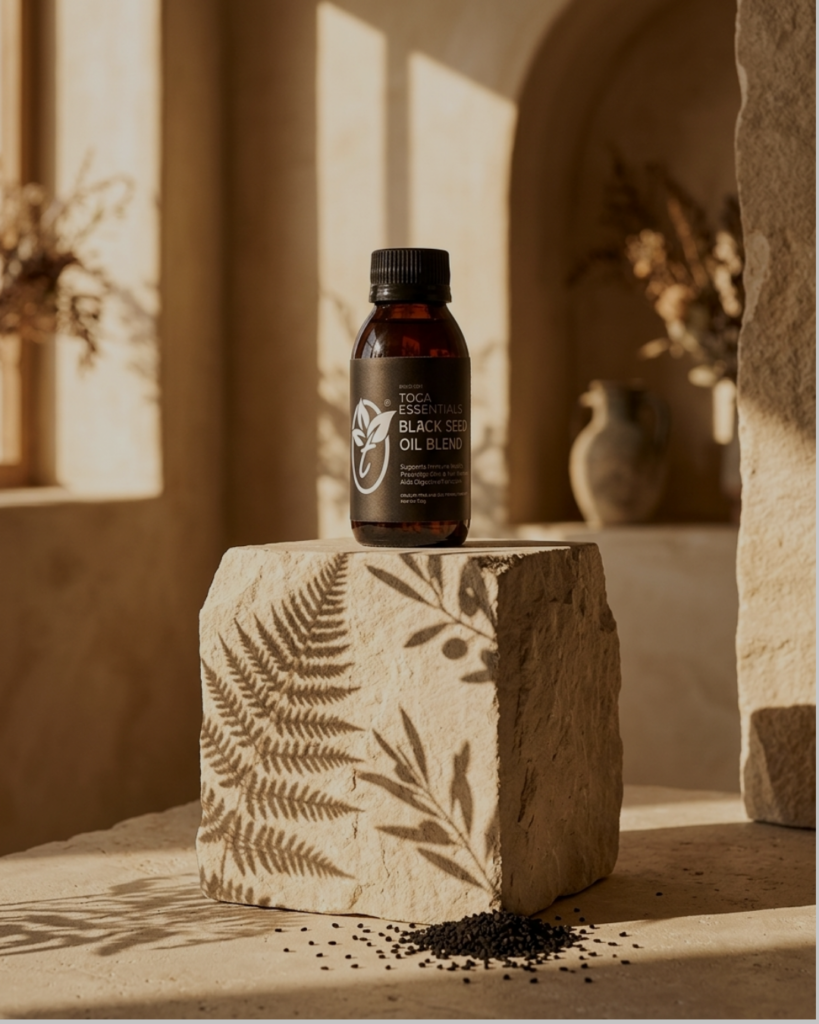
Our Toca Essentials Black Seed Oil is also blended with organic coconut oil, which helps make the experience somewhat more approachable.
The coconut oil also affects the oil’s texture.
If the weather is cold, you may notice that the oil becomes thicker or partially solidifies. This is a natural consequence of the coconut oil component rather than necessarily meaning that something is wrong with the product.
Our black seed oil is cold-pressed and blended with organic coconut oil that has been soaking black seeds for six weeks.
We are also currently putting the product through SABS testing as part of our ongoing quality and product-development process.
Is There Scientific Evidence That Black Seed Oil Works?
There is promising research—but “promising” is not the same thing as “proven to cure everything.”
Nigella sativa, commonly known as black seed or black cumin, has been studied in human clinical trials for areas including blood glucose, blood pressure, lipids and other health outcomes.
For example, one randomized clinical trial involving people with type 2 diabetes found improvements in several blood-glucose measures after 12 weeks of Nigella sativa supplementation.
Another randomized trial found that eight weeks of Nigella sativa oil supplementation was associated with improvements in several cardiometabolic markers in people with type 2 diabetes.
A more recent meta-analysis of randomized controlled trials also reported reductions in fasting blood glucose, HbA1c, total cholesterol and LDL cholesterol, although the researchers noted the need for further research.
This gives us an important takeaway:
Research supports investigating black seed as a complementary wellness ingredient—but it does not justify claiming that black seed oil cures diseases.
At Toca Essentials, our philosophy is simple:
Black seed oil can be part of your wellness routine. It should not be presented as a replacement for medical care.
So… How Long Should You Give Black Seed Oil?
If you’re taking black seed oil for general wellness, don’t judge it solely by what happens after one dose.
Some people may notice something within a few days.
Others may need several weeks before noticing a difference.
And some people may not experience a noticeable sensation at all.
If you’re using it for a specific health concern, the timeline becomes even more complicated because the outcome you’re monitoring may require proper measurement rather than simply asking, “Do I feel different?”
The best approach is to:
- Choose a quality product.
- Use it consistently and according to the product’s directions.
- Pay attention to how your body responds.
- Keep track of meaningful changes.
- Give your routine enough time to evaluate.
- Don’t stop prescribed medication because you have started using black seed oil.
- Speak to a qualified healthcare professional if you’re managing a medical condition or taking medication.
The Bottom Line
How long does black seed oil take to work?
There isn’t one answer.
Some people report noticing changes within a few days. Others notice changes over several weeks. Research examining measurable health outcomes has generally studied Nigella sativa over considerably longer periods—often 8–12 weeks or more.
What matters most is understanding that black seed oil isn’t a magic switch.
Your body is part of the equation.
Your diet is part of the equation.
Your consistency is part of the equation.
And your expectations matter too.
At Toca Essentials, we don’t believe in telling people that black seed oil “heals everything except death.”
We believe in something much more useful: traditional African and natural wellness ingredients deserve to be respected, explored and used responsibly—while being honest about what we know, what people experience, and what science has actually demonstrated.
Want to learn more about natural wellness?
Join the Toca Essentials Wellness Email List for practical wellness education, product insights, traditional ingredients and new Toca Essentials products delivered directly to your inbox.